L F I G
Call us for free Estimate
business hours
  • Mon-Fri: 09:00am - 5:00pm ALL DEPARTMENTS
  • Sat:  9:00AM-1:00PM PARTS AND SALES
  • Sun:  CLOSED

Hi! My name is Marley, and I can’t wait to greet you on your next visit !!

Levelling your Camper

Posted on Dec 17, 2025


How To Level a Camper


Getting comfortable in a campground is much easier when you know how to level a camper correctly the first time. Nobody wants to stumble around their RV, sleep off-kilter, or catch damage from a swinging entry door.

In addition to sleeping well during camping, appliances like refrigerators may not function if your RV isn’t adequately level. So, in this simple guide to leveling your RV, you’ll learn how to level your camper manually and with an automatic leveling system (if your RV is equipped).

Then you’ll be ready to kick off a relaxing camping trip!

Key Takeaways on How To Level a Camper

  • Importance of Leveling: Properly leveling your RV ensures comfort, prevents appliance malfunctions (like refrigerators not working), and avoids structural damage from uneven weight distribution.
  • Manual Leveling Process: This process requires tools like leveling blocks, chocks, and a bubble level. Steps include positioning the RV, using leveling blocks and chocking wheels, adjusting the tongue jack (for towables), and stabilizing with jacks—never using them to lift the RV.
  • Automatic Leveling Considerations: Even with an auto-leveling system, initial positioning matters. Parking on a relatively level surface, using jack pads, and avoiding lifting all wheels off the ground are crucial for safety and system efficiency.

Tools For Manual RV Camper Leveling

leveling block and a level on the ground

For RVers whose camper isn’t equipped with auto-leveling, you’ll need these RV essentials before arriving at your campsite.

  • Leveling Blocks
  • Wheel Chocks (Very important! Towables don’t have transmissions or parking brakes of their own, and motorhome wheels should still be chocked as an added safety measure, especially on uneven sites)
  • Bubble Level
  • Jack crank handle or Scissor Jack Drill Attachment (for RVs with manual stabilization)

With those items packed, you’ll be ready to level your RV when you set up camp.

Technician Tip: Per DOT requirements, wheel chocks should be wider than the width of RV tires. Although physical inspections can be rare, it is safer and far more effective than using narrower chocks.

How To Level a Towable Camper

Before stabilizing your RV, you must level it left to right and front to back. Follow these steps to level a travel trailer, fifth wheel, or other towable RV.

Position Your RV in the Site

Woman using RV backup camera to navigate into campsite

When backing into a campsite, try to get as close as possible to level from left to right. Rolling forward or backward can help you get closer to level. Place a handheld bubble level on the RV floor to check the level side-to-side.

Choose the Number and Location of Leveling Blocks

Woman placing stacking camper leveling blocks

Decide how far to raise the right or left tires to achieve level from left to right. If you’re close, try just one block. If you’re further off, try two or three. More than three isn’t recommended, so if you feel you need more, you may need to reposition your RV. Make it easier to drive onto the blocks by building a platform­––for example, use multiple blocks to make a triangular base.

Look at the angle of your campsite and trailer to determine whether it will be easier to roll back or pull forward onto the blocks. Let gravity help you. This will tell you whether to place blocks behind or in front of the tires.

Pull Onto Leveling Blocks and Check Camper’s Level

RV tire with blocks in front

Ideally using a spotter to guide you, pull onto leveling blocks slowly until the camper is centered on the highest block. If you’re alone, go slow and check placement several times. Set your parking brake each time you leave your tow vehicle. 

Next, use a bubble level to check the side-to-side level. If you are not level, you may need to remove the blocks, add another level, and repeat the process.

DON’T UNHITCH YET!

Chock Your Wheels

chocks - how to level your rv

When you’re content with your side-to-side level, place wheel chocks in front and behind at least one tire on either side, preferably one still contacting the ground. If you have to raise both sides of your RV to be level, you may need an X-style wheel chock that doesn’t require ground contact, but these only work with double axle trailers. A larger set of wheel chocks may be required for single-axle campers.

Unhitch

unhitch-how-to-level-your-rv-09-2022

With wheel chocks firmly in place, you can disconnect your tow hitch and pull your tow vehicle clear. If you’re towing a fifth wheel, avoid the most common fifth wheel mistake that new owners make. Guess it? You forgot to lower the tailgate!

Raise or Lower Tongue Jack

adjust-jack-how-to-level-your-rv-09-2022
Image by Camping World

Grab your bubble level again, but this time, place it on the floor inside your towable camper to check the front-to-back level. Adjust the level by raising or lowering the tongue jack or landing gear (for 5th wheels). Some jacks are power jacks, and some are manual hand-crank jacks.

Lower Stabilizing Jacks

Man extending travel trailer stabilizing jacks

With your camper level, set jack pads or additional leveling blocks under the locations where the jack feet will contact the ground. Lower or place your stabilizing jacks until they rest on the jack pads. Ensure equal pressure on all pads, but DO NOT over-extend! These jacks are for stabilizing only and should NOT be used to lift your RV to adjust the level. Don’t extend slide outs until your RV is level and stable.

Level your trailer by raising or lowering your fifth wheel landing gear or your travel trailer tongue jack. Some jacks are power jacks and some are manual hand-crank jacks.


How To Use a Camper’s Automatic Leveling System


For towables or motorhomes with an auto-leveling or a hydraulic leveling system, many think the process is as easy as pushing a button. But some precautions must be taken. Let’s walk through them:

Parking your RV

parking-how-to-level-your-rv-09-2022

You still need to start from a fairly level position. So get your bubble level out and check that you’re as level as possible when parking. For easier leveling, position the front of your camper on the lower end of an uneven campsite. 

It’s easier to raise the front than the rear, and lifting the front is a must for motorhomes because only the rear wheels are locked when you set the transmission in Park. 

Your RV could roll off the jacks if you raise one or both rear wheels off the ground, which should be avoided anyway. However, you can alleviate issues by setting the parking brake, if applicable, and placing wheel chocks in front and behind the front wheels.

Placing Jack Pads

placing leveling blocks - how to level your rv

Place blocks or jack pads under the camper’s leveling jack feet. Avoid placing them on icy or slick surfaces that could cause them to slip. Jack pads prevent jacks from sinking and protect the campsite pad.

Technician Tip: Remember that jacks can sink on hot asphalt.

Using Your RV Leveling System

auto leveling system - how to level your rv

Use your control panel to level your RV using your auto-leveling system. Your control panel will have lights telling you which corners are low. Use the corresponding buttons to automatically level your camper.

Use the control panel to operate your auto-leveling system. Most control panels have lights indicating which corners are low. Use the corresponding buttons to level your camper. These systems vary among fifth wheels and motorhomes and across manufacturers. 

Technician Tip: Consult your owner’s manual for specific details, but no matter which system you have, NEVER lift the wheels completely off the ground when extending front or rear stabilizing jacks.


Click on the picture to watch a training video.


Level-Up® 5th Wheel

After a few trips, this procedure will be old hat for you and your camping partners. Leveling your RV isn’t complicated, but it’s much easier if you do it right the first time.

Now that you know how to level your RV, where will you take it? Leave a comment below!


Your Next Great Adventure is Just Down the Road!!!

Towing weights explained

Posted on Dec 16, 2025


Understanding RV Trailer Weight Ratings


Understanding RV trailer weight ratings can be a big learning curve for first-time RVers, but this information protects your tow vehicle and RV while ensuring your safety. It’s why manufacturers place stickers on the exterior sidewalls of towable campers and inside motorhomes, so weight ratings are always readily available. While you may not be familiar with all the acronyms, these camper ratings don’t have to be intimidating. This RV ratings guide will help you become an expert in RV weights.

 Key Takeaways:
  • Understanding RV weight ratings (GVWR, UVW, CCC, GAWR, etc.) is essential for safe towing and vehicle longevity. It helps RVers avoid overloading and ensures they choose a camper their tow vehicle can handle.
  • Key weights to know include UVW (dry weight), GVWR (maximum loaded weight), CCC (cargo capacity), and towing capacity. Tongue/pin weight and GCWR also play critical roles in matching trailers and fifth wheels to vehicles.
  • Staying below 80% of your tow vehicle’s capacity and distributing weight properly help maintain safe driving conditions, protect your equipment, and avoid legal or safety issues.


Why Are Camper Weights So Important?

Even seasoned RVers benefit from periodic refreshers on RV trailer weight ratings. These ratings ensure safe towing and should be required information if you own or are purchasing a towable camper. That’s travel trailers, fifth wheels, destination trailers, etc. They’re also critical to avoid overloading your trailer. 

RV shoppers must know their tow vehicle’s weight ratings to choose a camper they can tow safely—and one that won’t wear out their truck or SUV in a few short years. Check your vehicle’s towing capacity using an online towing calculator. But you’re likely here to solve a simple question: what do all these weight rating acronyms mean? GVWR, CCC, GAWR…let’s solve the mystery.

For Towable Campers

Use these camper weight rating definitions to help you choose a safe trailer and load it without overtaxing your tow vehicle.

UVW = Unloaded Vehicle Weight

Also referred to as "Dry Weight,” unloaded vehicle weight, or UVW, is the weight of the RV without any liquids, passengers, or cargo. When you buy a new RV, this is the weight you’ll tow when you hook up your trailer and pull it home—before adding water, sewer, electrical equipment, camping gear, kitchen essentials, and more. 

02265_Weight Ratings Graphics_0525_UnloadedVehicleWeight

GVW = Gross Vehicle Weight

Gross vehicle weight, or GVW, is the weight of your RV with liquids, passengers, and cargo. You’ll tow this weight once you add everything you want to enjoy your RV adventures. 

 Wondering what your GVW is? Head to your nearest highway truck weigh station or any truck scales with your fully loaded setup to get accurate numbers.

02265_Weight Ratings Graphics_0525_GrossVehicleWeight

GVWR = Gross Vehicle Weight Rating

Gross vehicle weight rating, or GVWR, is the maximum allowable weight of your RV when fully loaded with liquids, passengers, and cargo. Your actual gross vehicle weight, or GVW, should not exceed your RV GVWR as specified by the manufacturer.

RV Pro Tip:  GVWR should be used when evaluating hitch and tow vehicle options. MTO traffic enforcement will issue citations based on rated capacities even if the actual weight is within code.

CCC = Cargo Carrying Capacity

Wondering how much liquid, passengers, and cargo you can carry? Then you’re wondering about your CCC. Use this simple formula to calculate how much weight you can take on board.

  RV Pro Tip: CCC = GVWR - UVW

02265_Weight Ratings Graphics_0525_CargoCarryingCapacity

GAWR = Gross Axle Weight Rating

Gross axle weight rating is the maximum weight your axles are rated to accept. It’s important when loading up your RV. Note where you place your heaviest items to avoid placing too much weight ahead of or behind the axles. Spread your cargo weight evenly throughout your RV.

RV Pro Tip: Axle capacities will add up to more than the vehicle’s GVWR. This doesn’t mean you can carry more cargo than the GVWR suggests. Dynamic loading on the individual axles varies during travel (cornering, starting, and stopping), so the axles must be stronger than the minimum static load of the RV at rest.

Tongue Weight – For Any "Bumper Pull” Camper

Tongue weight is the weight of the trailer’s tongue that will be placed on your tow vehicle’s hitch ball.

Pin Weight – For Fifth Wheels

Hitch or pin weight is the weight of the fifth wheel’s front pin that will be placed on your tow vehicle’s fifth wheel hitch in the truck bed.

For Tow Vehicles

These weights are essential for tow vehicles. Some, like curb weight, come into play when towing a vehicle behind an RV. Others, like maximum towing capacity, are critical when shopping for a towable camper. 

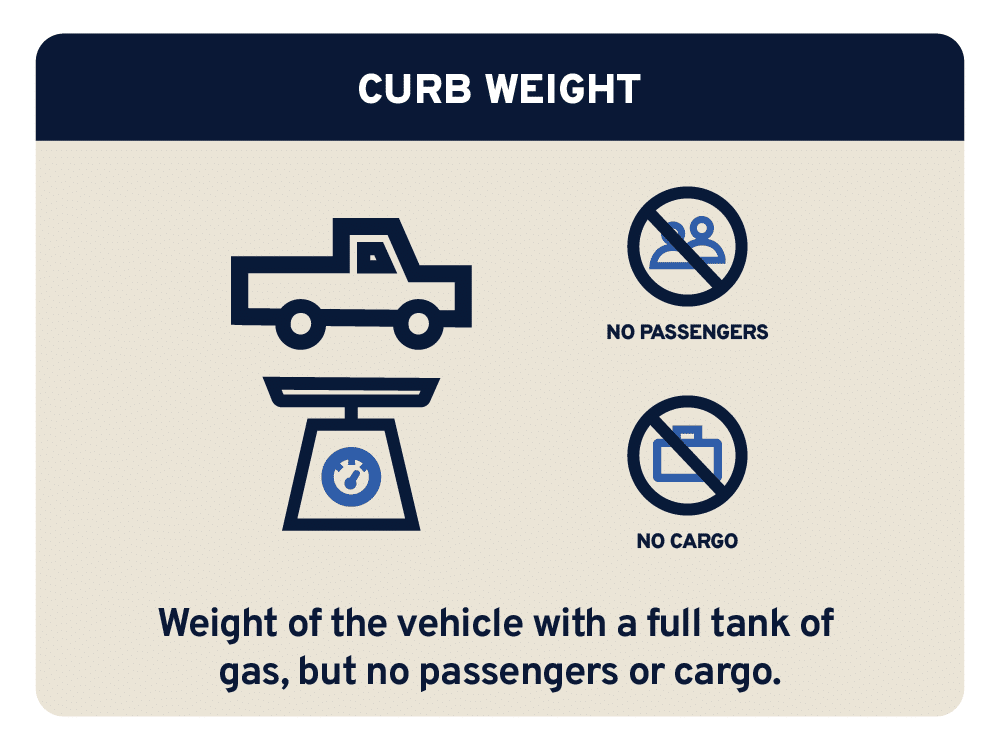
Curb Weight

Curb weight is the weight of a vehicle without passengers or cargo, but it is usually listed accounting for a full gas tank.

02265_Weight Ratings Graphics_0525_CurbWeight

Towing Capacity

Towing capacity is the maximum weight that your tow vehicle is rated to tow. The camper’s GVWR should never exceed the tow vehicle’s towing capacity for towable campers. The secondary vehicle’s curb weight must remain below the RV’s towing capacity for towing behind a motorhome.

RV Pro Tip: Think about how you will travel in your RV. Will you be full-timing with most of your possessions? Or will you take short weekend trips with only the essentials? Consider how much you anticipate loading your trailer, leaving ample room between your tow capacity and GVW. Many experienced RVers try to keep their GVW below roughly 80% of towing capacity.

02265_Weight Ratings Graphics_0525_TowingCapacity

Tongue Weight Rating

A tow vehicle’s tongue weight rating is the maximum weight that can be placed on the hitch without impairing safety or stability. Ensure your trailer’s hitch weight does not exceed this number.

RV Pro Tip: Don’t forget items that add to your trailer’s tongue weight, like heavy cargo stored in the forward pass through compartment or tongue-mounted Rv bike racks Extra weight added to this linking point can cause loss of control.

Payload Capacity

Payload capacity is the maximum weight your vehicle can carry, including cargo, passengers, fuel, and anything else. When fifth wheel towing, the RV’s hitch or pin weight should not exceed your vehicle’s payload capacity when added to the weight of passengers, fuel, and other cargo.

For Trailers and Tow Vehicles

Consider this additional vehicle and trailer weight rating to ensure safe towing. 

GCWR (Gross Combined Weight Rating)

Gross combined weight rating, or GCWR, is the maximum allowed weight of a tow vehicle, its payload, and the trailer it is towing, including liquids, passengers, and cargo. In most cases, you’ll need a location with RV weight scales to determine your GCWR.

RV Pro Tip: Stay well under the maximum GCWR to ensure safe braking on the road.


These RV trailer weight ratings are essential to finding your perfect RV and maintaining your equipment. A knowledgeable RV salesperson can help you find a trailer or fifth wheel that you can safely tow. Generally, it’s best to err on the side of caution. When calculating weight allowances, many RVers strive to stay under their recommended ratings. This prevents strain on the tow vehicle and trailer while ensuring safe driving conditions for you and others.


Your Next Great Adventure is Just Down the Road!!!

Parks

Posted on Dec 15, 2025

Your Guide To RV Parks in Ontario

Ontario is home to some of Canada’s most scenic and well-equipped RV parks, offering travelers the perfect blend of comfort, adventure, and natural beauty.

Whether you’re planning a quiet weekend getaway or an extended family road trip, Ontario’s network of parks provides a welcoming home base for every style of RV.

Here’s a simple guide to a few great destinations, plus how to book your next stay!

1. Deer Creek Conservation Area

Location: Norfolk County

If you’re looking for a northern-Ontario-style escape without the long drive, Deer Creek Conservation Area delivers just that.

Highlights:

  • 40 campsites, including 13 with electrical service
  • Large group camping area for youth programs and gatherings
  • 80-acre reservoir perfect for canoeing, kayaking, and fishing
  • A small swimming beach ideal for cooling off on warm summer days
Amenities:
  • Modern washrooms and showers
  • Picnic tables and group picnic pavilions
  • Firewood, ice, and bait sales
  • Children’s fishing derbies and canoe rentals
  • Boat ramps and fishing docks for easy access to the water

Booking Info:
To reserve your site, call 1-877-990-9934. Availability varies by season, and reservations are recommended, especially for serviced lots or group areas.

2. Black River Wilderness Park

Location: Washago

For travelers craving an immersive nature experience, Black River Wilderness Park offers 180 acres of pristine wilderness centred around the scenic Black River.

Highlights:

  • RV sites with 15 or 30-amp electrical hookups and water connections
  • Peaceful surroundings with forest and river views
  • A balance of modern comfort and wilderness charm

Amenities:

  • Controlled access gates for safety
  • Clean, maintained washrooms and showers
  • Convenience store stocked with essentials
  • Pet-friendly environment
  • Fire pits and picnic tables at every site
  • Community events and walking trails throughout the summer

Booking Info:
Reserve online via the Black River Wilderness Park website, call 705-689-2502, or email info@blackriverwildernesspark.ca.

3. Sandy Beach Trailer Court

Location: Fenelon Falls

If your perfect camping trip includes sand between your toes and lakeside breezes, Sandy Beach Trailer Court on Cameron Lake is a must-visit destination. This family-friendly RV park combines resort comfort with classic camping charm.

Highlights:

  • Seasonal trailer sites and overnight camping spots
  • Direct access to beaches and boating on Cameron Lake
  • Relaxed, community-oriented atmosphere

Amenities:

  • Modern washrooms and showers
  • Camp store for supplies
  • Pet-friendly sites with both shaded and open options
  • Fire pits, electric hookups, and water access
  • Activities like swimming, boating, and lakeside picnics
Booking Info:

Call 705-887-2550, email info@sandybeachresort.ca, or use the reservation form on their website. Book early—availability fills quickly during peak summer months.

How to Book an RV Site in Ontario?

Booking your ideal RV site in Ontario is straightforward, but the process varies depending on the park type.

Tips:

  • Private Parks (like Sandy Beach and Black River) offer direct booking through their websites or by phone.
  • Provincial Parks can be reserved online through the Ontario Parks reservation system.
  • Smaller or rural parks may operate on a first-come, first-served basis — arriving early can help secure your spot.

Before booking, review each park’s policies carefully. Some restrict the number of guests per site, open fires, or certain cooking appliances. Check for vehicle size limits or tent restrictions on RV sites to avoid surprises upon arrival.

What Types of RVs Are Welcome?

Most Ontario RV parks accommodate a wide range of vehicles, but it’s worth confirming before booking.

Commonly Accepted RV Types:

  • Motor homes
  • Travel trailers
  • Fifth wheels
  • Pop-up campers

Note on Park-Model RVs:
Park models (or park trailers) are larger, semi-permanent units designed for long-term stays. Many parks — particularly conservation and provincial ones — do not allow park models due to their size and installation needs. Always contact the park in advance if you have a seasonal or stationary trailer.

Planning Your Perfect Ontario RV Getaway

Ontario offers something for every kind of traveler — from lakeside relaxation and forested solitude to family-friendly recreation.

Recap:

  • Deer Creek Conservation Area: Family-friendly fun and a peaceful reservoir setting
  • Black River Wilderness Park: Pristine wilderness with modern amenities 
  • Sandy Beach Trailer Court: Lakeside comfort and community atmosphere

Final Tips:

  • Book early — July and August fill up quickly.
  • Confirm hookup levels and site size before arrival.
  • Travel with a reliable RV from a trusted dealership like Keith’s to ensure a smooth adventure.

With thoughtful planning and a spirit of adventure, your next Ontario RV getaway is only a drive away.

Need The Perfect RV For Your Upcoming Adventure? Trust Adventure RV in Waterford, Ontario!

Looking for the right RV or trailer for your family’s upcoming adventure across Ontario? You can rely on the experienced team at Adventure RV Centre to help you find your perfect home away from home. With years of experience, a reputation for honesty, and a team that truly listens to your needs, Adventure RV isn’t just about selling RVs—it’s about helping you find the perfect fit for your lifestyle.

At Adventure RV Centre, our sales team provides each customer with personalized guidance to help each family find the perfect trailer or RV. We also offer competitive pricing, and are proud to say that we offer the lowest prices in Canada! When you choose your next trailer from Adventure RV Centre, you’ll discover why so many families in Ontario trust us when it comes to buying their trailer.

Adventure RV Centre is located just west of Waterford, Ontario, and has been a beloved part of our small town since 1997. As a family-run, Canadian-owned business, we are dedicated to providing top-quality service and building lasting relationships with all of our customers.

Share Button

Back up Camera

Posted on Dec 14, 2025

Do You Need a Backup Camera for Your RV?

Backing up an RV is one of the most intimidating tasks for new owners, especially if you’re used to driving smaller vehicles. From tight campsites to tricky storage lots, visibility is everything. That’s why more RVers are upgrading with a backup camera. It’s a simple addition that delivers major peace of mind. 

In this guide, we’ll break down the benefits of adding a backup camera to your RV, how to check if your rig is prepped for an easy plug-and-play installation, and the different types of backup camera systems available so that you can hit the road (and reverse) with confidence.


Key Takeaways

  • Backup Cameras enhance Safety and Ease of use by improving rear visibility, reducing blind spots, and simplifying parking, especially for first-time RVers.
  • Many RV's come pre-wired for cameras, allowing for straightforward plug-and-play installation; otherwise, a custom install may require additional tools and effort.
  • Camera systems options vary by type (wired vs wireless), features (rear-only vs multi-camera), and display methods (dash monitor, smartphone, or standalone screen), with brands like Furrion, Voyager, and Trailer Life offering popular solutions.


Why a Backup Camera Is a Smart Upgrade for Your RV

Dash-mounted display for observation camera in tow vehicle

If you’re a first-time RVer, a backup camera significantly reduces stress by giving you a real-time view of what’s behind you. Nobody likes the pressure of interested eyes when pulling into a campsite, but a backup camera is an excellent tool for added visibility. 

Here are a few key benefits:

  • Enhanced visibility: A backup camera reduces blind spots and helps you avoid obstacles, people, or pets that might be behind your RV.
  • Simpler Parking: Confidently back into tight spaces, even without a spotter.
  • Accident Prevention: Minor collisions can lead to expensive repairs. A camera helps prevent backing into trees, posts, or other RVs.
  • Peace of Mind: Added visibility takes the guesswork out of reversing and boosts your driving confidence.


Is Your RV Pre-Wired for a Backup Camera?

Back of Keystone Cougar 5th wheel

Before buying a backup camera, it’s essential to know whether your RV is pre-wired—meaning it’s set up for a relatively simple, plug-and-play camera installation. 

Most pre-wired RVs have a circular or rectangular plastic mount on the upper rear wall. The mounting plate may have a label that says "backup camera prep” or list the brand name. Furrion and Voyager are two common brands with pre-wired systems. The presence of a label and/or mounting plate typically means the RV is wired to power a compatible camera.

These pre-wired systems usually tie into the RV’s marker lights. When the running lights are on, power flows to the camera. If your RV doesn’t have a mounting plate, you can still install a backup camera—it may require more tools, wiring, and time.


Types of RV Backup Camera Systems

Once you’ve confirmed whether your RV is pre-wired, choose the correct backup camera setup. There are several types; the best depends on your needs and budget.

Wireless vs Wired Systems

Couple sitting in cockpit of Freedom Elite camper van

Wireless cameras transmit video to a monitor or compatible smartphone. They’re arguably the easiest backup observation systems to install because they don’t require running a cable the length of the RV. This makes them an excellent choice for DIY installations where the RV isn’t prepped. However, wireless RV backup cameras are more susceptible to signal interference, which makes them less reliable on larger RVs or for those who want a camera they can monitor during travel.

Wired backup cameras connect directly to a dash-mounted monitor via a cable. They’re more common in motorhomes, but there are systems for towable RVs compatible with the 7-pin connector used to plug in a trailer to a tow vehicle. Because they don’t require a wireless connection, they offer more reliable signal quality and no video lag. However, hardwired RV backup cameras generally require a more complex installation—best completed by a certified RV technician.

Rear-View vs Multi-Camera Observation Systems

Couple shopping for a backup camera for their RV

Most RVs are equipped with or prepped for rear and side view camera. The most common systems have a single rear-view camera. Side-view and over-door cameras provide additional visibility for changing lanes and reversing. They also improve security by allowing you to monitor your RV’s entry points. 

It’s rare to find a camper with side-view and door cameras that doesn’t also have a rear-view camera. These complete RV observation systems can support up to four cameras and are best for larger motorhomes, fifth wheels, and toy haulers. 


Monitor Options

Woman pointing at RV backup camera display

Depending on the system, RV backup cameras connect to an in-dash display, a standalone monitor, or your smartphone. Dash displays are most common in motorhomes, while wireless monitors and smartphone-connected cameras are ideal for towables and DIY installs. Check compatibility with your RV and tow vehicle before buying.

Technician Tip: Some aftermarket backup cameras for RV trailers may integrate with your tow vehicle’s in-dash display, but it’s rare. Check with your tow vehicle’s manufacturer to learn more about compatible options.

Some of the top brands for RV backup cameras include:

  • Furrion Vision S – A favorite for RVs pre-wired with Furrion mounts. Reliable wireless signal and excellent night vision. Rear-view only and multi-camera models are available.
  • Trailer Life – Easy options for pre-wired RVs, featuring two different dash-mounted monitor sizes.
  • Voyager – Common in many travel trailers and fifth wheels; often seen with pre-wired brackets.

Installation Basics and What to Expect


Installation can be surprisingly simple if your RV is pre-wired for a bacup camera. The easiest DIY installs will be wireless systems that sync to your smartphone because there’s no display to mount. Typically, you’ll only need a screwdriver, a ladder, and a little patience to install the camera, download the app, and sync the system.

Plug-and-play RV backup cameras attach directly to the pre-wired bracket on the back of the camper. Some come with their own bracket to replace existing prep housing. For power, they simply connect to the prepped wiring and turn on when your running lights are turned on.

For RVs without backup camera pre-wiring, you’ll need to drill for a mounting bracket, route cable, and connect the camera to a 12V power source. If that sounds daunting, professional installation is a great option.

Is a Backup Camera Right for You?


If you’re a first-time RV owner, adding a backup camera is one of the most worthwhile upgrades you can make. It improves safety, reduces stress, and helps you maneuver confidently, especially when you’re still learning the ropes of RV driving.

Whether your camper is prepped for a quick install or needs a more custom setup, there’s a camera system that can fit your needs and budget. And once it’s in place, you’ll wonder how you ever navigated your RV without one.

 Your Next Great Adventure is Just down the Road!!!


Choosing a Family Trailer

Posted on Dec 13, 2025

How to Choose a Family Travel Trailer: Practical Tips for Kids, Storage, and Sleep Space

Expert Tips And Essential Insights For Memorable Family Adventures On The Road

Embarking on a road trip in a family travel trailer opens the door to unforgettable memories, greater flexibility, and an unmatched sense of adventure. As more families turn to RV travel for its comfort, convenience, and safety, selecting the right travel trailer has never been more critical. Whether you’re a seasoned explorer or planning your first cross-country journey, choosing a family travel trailer tailored to your needs ensures every mile is enjoyable and every night is restful. This guide will walk you through key factors, expert advice, and must-have features, empowering you to make the best decision for your family’s next big adventure.

Understanding Family Travel Trailers: Key Features And Benefits

Family travel trailers are specially designed recreational vehicles (RVs) that offer a blend of home-like amenities and mobility, making them ideal for families seeking both comfort and adventure on the road. From cozy sleeping quarters and spacious kitchens to sturdy safety features, these trailers provide a reliable base for family vacations, long weekends, or even extended travels.

What Sets Family Travel Trailers Apart?

  • Customizable Living Spaces: Multiple floor plans allow you to prioritize sleeping arrangements, communal spaces, and storage solutions.
  • Ample Storage: Large cargo holds, cabinets, and under-bed compartments keep all your family essentials organized.
  • Enhanced Safety: Family travel trailers come equipped with safety features such as anti-sway bars, brake controllers, and reinforced frames designed for peace of mind.
  • Convenience on the Road: Equipped with fully functional kitchens and bathrooms, these trailers let your family enjoy home-cooked meals and private amenities wherever you go.

Essential Considerations When Selecting A Family Travel Trailer

Finding the ideal family travel trailer entails balancing lifestyle preferences, budget, and safety. Here’s what to prioritize for a confident and informed purchase:

1. Sleeping Capacity And Layout

Consider the number of family members and guests who’ll be joining your trips. Look for bunkhouse models, convertible dinettes, and master suites to comfortably fit everyone.

2. Tow Vehicle Compatibility

Check your vehicle’s towing capacity before selecting a trailer. Exceeding this limit can compromise safety and vehicle performance. Use online towing calculators and consult with a reputable dealer for guidance.

3. Essential Amenities

  • Full-size kitchen appliances for meal prep flexibility
  • Private bathroom with shower and toilet
  • Entertainment features (TV, Bluetooth speakers, USB ports)
  • Outdoor kitchens or awnings for al fresco living

4. Storage Solutions

Adaptable storage, such as exterior compartments and under-bunk drawers, ensures you can pack extra clothing, sports gear, and groceries for extended journeys.

5. Safety Features

Choose trailers with integrated smoke and carbon monoxide detectors, emergency exits, and heavy-duty tires. Safety extends to towing equipment—never overlook the quality of hitches, jacks, and tire pressure monitoring systems.

6. Budget and ownership costs:

Factor in not just the purchase price but also insurance, maintenance, campground fees, and potential upgrades. Pre-owned trailers may offer excellent value for budget-conscious families, but always conduct thorough inspections.

Top Family Travel Trailer Models For Every Adventure

The market offers a wide range of family travel trailer options, from ultra-lightweight models to spacious luxury rigs. Here are some standout choices to help narrow your search:

  • Palamino Puma and Puma Camping Edition: Known for durable construction and family-friendly layouts, including multiple bunkhouse configurations.
  • Forest River Rockwood: Offers lightweight build and clever storage innovations, perfect for mid-sized families.
  • Forest River Wolfpack Toy Haulers: Off the ability to pack up all the toys and take the family to the Adventure!

Always compare floor plans, features, and dealer support. Visit trusted RV dealers or attend an RV show like the one in London, Ontario on the Family Day weekend in February to see the latest models and technology in person.

Safety Tips And Best Practices For Family Travel Trailer Adventures

Even with the perfect family travel trailer, safety takes precedence. Follow these essential tips to keep your journeys secure and stress-free:

  • Inspect your trailer before each trip: Regularly check tire pressure, brakes, lights, and hitch connections.
  • Evenly Distribute Weight: Properly load gear and essentials to prevent swaying and improve tow stability.
  • Practice Defensive Driving: Allow extra stopping distance, avoid sudden maneuvers, and be mindful of height restrictions when planning routes.
  • Run Safety Drills: Teach family members how to exit in an emergency, operate fire extinguishers, and locate first-aid supplies.
  • Stay Connected: Utilize GPS trackers, two-way radios, or mobile apps for real-time communication with friends or family.


Maintaining Your Family Travel Trailer For Longevity

Routine maintenance not only protects your investment but also enhances safety and comfort. Follow these expert recommendations:

  • Inspect roof seals, windows, and doors for leaks or damage each season.
  • Flush and sanitize water systems regularly, especially before and after storage.
  • Keep electrical systems and batteries in top shape with annual checks.
  • Lubricate slide-outs, hinges, and jacks to ensure smooth operation.
  • Store your trailer in a covered or climate-controlled location during off-seasons, if possible.

For in-depth maintenance guides, check the manufacturer’s manual or join online RV owner communities for real-world advice and troubleshooting tips. At Adventure RV Centre we offer all kinds of parts and services to assist in keeping your coach in top condition and stocked with all of the necessities.

Frequently Asked Questions About Family Travel Trailers

What Size Travel Trailer Is Best For Families?

The ideal size depends on your family’s needs. Most families of four or more opt for travel trailers between 25 and 35 feet, prioritizing bunkhouse models and convertible common areas for added comfort.

Can I Tow A Family Travel Trailer With My SUV?

Many half-ton trucks and some larger SUVs are capable of towing lightweight to medium-sized family travel trailers. Always verify your vehicle’s maximum towing rating before purchase.

What Are The Top Features To Look For In A Family Travel Trailer?

Key features include multiple sleeping areas, a full bathroom, spacious kitchen, climate control, built-in storage, and reliable safety equipment. Extras such as entertainment systems, awnings, and solar readiness can further enhance your experience.

Conclusion

Finding the right family travel trailer is the foundation for years of inspiring journeys and lasting memories. By considering your family’s unique needs, investing in safety, and performing regular maintenance, you unlock a world of accessible adventure—from scenic weekends in Provincial parks to coast-to-coast explorations. With the insights and expert guidance shared here, you are equipped to choose the ideal family travel trailer with confidence and peace of mind.

Ready to embark on your next adventure? Start exploring the options that we have here at Adventure RV Centre today and transform the way your family experiences the open road!


Contact us Today!


Your Next Great Adventure is Just Down the Road!!!

Used Travel Trailers

Posted on Dec 12, 2025

Used Trailers For Sale | Adventure RV Centre

If you’re looking for used trailers for sale in Ontario, Adventure RV Centre is the ideal place to start! We specialize in matching customers with the right trailer – not just the newest one – and our used inventory often includes gently pre-owned units that provide excellent value without sacrificing reliability, features or comfort. 


Why Choose a Travel Trailer, Fifth Wheel, Hybrid or Toy Hauler?

A trailer is one of the most versatile ways to explore the outdoors. They offer more amenities than tent camping, far more space than a teardrop or micro camper, and the flexibility to detach from the tow vehicle once you’re set up at a site.

Travel trailers along with fifth wheels, hybrids and toy haulers appeal to many campers because….

  • • They provide more interior space for extended camping or living
  • • They typically include full bathrooms, kitchens and sleeping areas 
  • • They are compatible with many trucks and larger SUVs
  • • They allow long-stay seasonal parking or frequent travel
  • • They offer excellent resale value

Because they provide so much room and functionality, used travel trailers for sale at Adventure RV Centre often attract families, retirees, and first-time RVers who want comfort and flexibility.


Why Consider Buying Used Instead of New

Buying a used trailer can be an excellent financial and practical decision – especially for new RV owners or seasoned campers.

People often choose a used trailer because:

  • • Lower purchase prices compared to new models
  • • A slower depreciation curve – used units keep their value better
  • • You can afford a higher-feature trailer at a lower cost
  • • Proven reliability – real-world use confirms that it is a functional unit
  • • Insurance and registration are usually lower for used units

A used trailer lets you step into the RV lifestyle affordably, and because many of our used units have been well-maintained or lightly used, they often feel nearly new!

 We frequently carry used units from trusted manufacturers such as….


Travel Trailers for Sale | Waterford, Ontario

Posted on Dec 11, 2025

Travel Trailers For Sale | Waterford, Ontario

December 13, 2025

At Adventure RV Centre, we have a wide range of travel trailers for sale. Our huge inventory of available trailers includes both new travel trailers and used travel trailers – there is a trailer for every preference, need and budget! Learn more about our travel trailers below, or browse our inventory here. If you have any questions, please reach out to us by texting or calling at 519-443-0291. We can also be reached by emailing us at sales@adventurervctr.com. We would love to help you find the perfect trailer for you and your family.

Why Travel Trailers Are a Top Choice for Canadian RVers

If you’re new to the world of trailers and RVs or simply looking to upgrade your current rig, travel trailers are a fantastic option to consider. Known for their versatility, affordability, and wide range of styles, travel trailers are among the most popular types of RVs or trailers on the market today!

Travel trailers come in a wide variety of styles and have a low price point in comparison to other options. Whether you’re working with a modest budget or seeking something a bit more high-end, there’s a travel trailer to fit your unique needs.

With so many different shapes, sizes, and floor plans available, it’s easy to find one that fits your lifestyle, whether you’re a solo traveler, a couple looking for weekend getaways, or a large family in need of room to accommodate the kids.

Travel trailers come in a variety of different styles!

At Adventure RV Centre we carry an extensive selection of travel trailers to suit every kind of adventurer. From compact, light weight trailers that are easy to tow and perfect for quick escapes, to spacious, luxury trailers packed with all the comforts of home, we’ve got something for everyone.

Not sure what type of trailer is right for you? The experienced, knowledgeable and professional team at Adventure RV Centre is here to help guide you through the options and find the perfect fit for your needs and budget. You can browse our full inventory of travel trailers for sale right here in Erin—or better yet, come visit us in person to explore them for yourself!

Types of Travel Trailers Available at Adventure RV Centre | Voted best RV Sales and Service Centre in Ontario

If you haven’t yet browsed our large collection of trailers for sale, we are happy to let you know that we offer travel trailers in a wide range of styles, including:

  • Lightweight Travel Trailers (great for SUVs!)
    Perfect for smaller tow vehicles like SUVs, lightweight travel trailers offer easy towing without sacrificing comfort.
  • Luxury Travel Trailers (full amenities, larger sizes)
    Luxury travel trailers come fully equipped with residential-style kitchens, large bathrooms, and upscale finishes for a high-end camping experience.
  • Bunkhouse Travel Trailers (ideal for families)
    These trailers are designed with families in mind, featuring built-in bunk beds and flexible sleeping arrangements for kids and guests.
  • Couples’ Travel Trailers (cozy, compact layouts)
    Compact and cozy, couples’ travel trailers provide everything two people need for weekend getaways or extended road trips.

Travel trailers come in many different layouts, price points and styles!

Have your eye on a specific brand or model? At Adventure RV Centre, we carry top trailer brands, ensuring you can find the highest quality travel trailer to meet your needs. Many manufacturers offer a wide range of brands.

Some of the brands we carry include

Forest River Trailers

  • Rockwood
  • Geo Pro
  • Roo (hybrid trailer)
  • Mini Lite
  • Ultra Lite
  • Signature
  • Puma
  • Puma travel trailers, Destination Trailers, Fifth wheel trailers
  • Puma Camping Edition Trailers
  • Wolfpack Toy Haulers

We’re proud to carry some of the most trusted and recognized travel trailer brands in the industry. With our large selection of travel trailers, we have something to suit every lifestyle and budget.

These brands have earned a strong reputation among Canadian RVers for their value, comfort, and ease of towing. No matter what kind of camping experience you’re after, you’ll find a brand you can trust right here at Adventure RV Centre, Ontario.

Frequently Asked Questions: Travel Trailers

Not quite sure if a travel trailer is right for you? Ready to learn a bit more before you take the plunge? If you are new to the world of trailers or planning to switch over from a different style of trailer, we can help. Browse our frequently asked questions below to learn more about travel trailers.

What is the best travel trailer for a small family?

Fortunately, there are a lot of amazing options for small families. If you are sleeping more than two people and need to accommodate kids or guests, you will likely want to invest in a bunkhouse style trailer. Bunkhouse trailers have a larger floor plan and room to sleep more family members.

How much does a travel trailer cost in Ontario?

Travel trailers are one of the more affordable options – but the price will depend on a number of factors. For example, are you buying a brand new trailer, or would you like to purchase a used pre-owned instead? Additionally, size and external and outdoor features will impact the cost. At Adventure RV Centre our travel trailers range in price to fit every budget starting at under $20,000.

Can I tow a trailer with an SUV?

Yes, many SUVs are capable of towing a trailer. However, you will need to find your specific make and model to find out how much weight your SUV is safely able to tow.

Do I need a special license to tow a trailer in Ontario?

No – in Ontario, you only need your standard G class license to tow a trailer.

Will my trailer come with a warranty?

We do everything we can to make sure that ALL of our RVs and trailers work for our customers. All our trailers come with a one-year manufacturer warranty for your peace of mind.

Where can I camp with my trailer?

In Ontario, there are many provincial parks, private parks and RV parks that you can camp on! Destination Ontario is another valuable tool to help you find your perfect camping location.

Visit Us in Waterford, Ontario To Find Your Perfect Travel Trailer | Canadian Owned and Operated

Located just west of Waterford, Ontario, Adventure RV Centre has been a beloved part of our small town since 1997. As a family-run business, we are dedicated to providing top-quality service and building lasting relationships with our customers. At Adventure RV Centre, we offer all of our customers an exception experience, including personalized service, competitive pricing on all of our products and quality assurance.

Ready to buy your travel trailer? We believe in going the extra mile for our customers. With every trailer purchase, you’ll receive a full walkthrough and hands-on demonstration, so you feel confident operating your new unit. We offer a one-year manufacturer warranty on all of our trailers.

Browse available new and used trailers now!


Your Next Great Adventure is Just down the Road!!!

Regards!

Posted on Dec 11, 2025


Hello, my name is Peter.  My wife Lori and I are the owners here at Adventure RV Centre just outside the village of Waterford, Ontario.  We are located south west of Hamilton and directly south of Brantford.  The setting is rural and the dealership is a good size, situated on approximately 7 acres of land.  We boast a large selection of both new and used units of all configurations from many well known companies in a no pressure, camper friendly environment.  We are a full service dealership with a full accessory department and excellent repair facilities. We have tripled our staff since we purchased in June of 2003 to include a full time sales manager, Ralph, financing broker,Jim, a parts and accessory specialist, Greg, a service manager/writer, Bryan, warranty administrator, Kathy, 2 full time experienced techs, Jon and Jack, fully propane certified, a detailer, Lori and our official Greeter, a Red lab named Mabel, all in an attempt to provide you, the customer, with exceptional service and lasting memories.  MY job, is to provide my staff with the necessary tools to allow both the dealership AND them to succeed AND you with assistance through every part of the process of owning a trailer.

I truly hope that you take the time to visit and experience the Adventure RV Difference.  Remember, YOUR next great Adventure is Just Down the Road!


Sincerely,

Peter Hotz, CET


P.S.  Take advantage of my training modules.  They can be accessed on the "Service Tab". Anyone that has had one of my "walk throughs" when they have purchased a trailer will be pleasantly pleased that they can now review this same information in the privacy and comfort of their homes! 


Your Next Great Adventure is Just Down the Road!!!


INSECTS, SPIDERS, TICKS, ANTS OH MY!!!

Posted on May 26, 2015

Good afternoon fellow campers!!  We have been busy here at the dealership and in one of my training sessions it came to me that in the environment that we use our trailers there are any number of insects that also call the outdoors their home.  Quite and epiphany!!!  I don't know how many times we get service calls because an insect or a variety of insects has wrecked havoc on someone's appliance like a water heater, refrigerator, air conditioner etc.  You can't fault the little beasts for trying to find a nice home BUT the damage and grief they can cause is HUGE.  Over the years I have seen several water heaters catch on fire from propane blow back when the supply tube is blocked with a spider web.  Refrigerators that are supposed to automatically switch to gas don't when a spider blocks the orifice.  Air conditioners vibrate etc. when "mud dobber" hornets make a nest in the fan assembly.   We have a product at our disposal that we have been using for a couple of years now that is called Bug Tek by Aquatek.  I had written an article on it when we first introduced it so it worth repeating and giving you some practical applications.  Bug Tek is a derivative of a chemical used in hospitals and veterinary medicines.  It is Permethrin.  THIS derivative is not harmful to warm blooded animals including our pets and humans.  Once applied it lasts for several weeks if not months.  Any insect that walks over it will shortly thereafter expire even if the product has dried.  It is non staining and invisible.  My suggestion is to spray your water heater, refrigerator compartments and inside of your AC shroud.  Reapply every month for best results.  Any insects that attempt to enter these compartments will perish quickly leaving you to enjoy your trailer.  Use the product inside the trailer around door openings, inside storage cabinets so that if ants etc.  get in they too will perish.  Another great use is to spray our clothing when out walking in the woods to protect against ticks.  Ticks have been in the news as of late as more and more are being found to carry Lyme disease.  Please note that you still should perform a physical tick check at first chance and the use of Bug Tek does not relegate one from doing so.  It is just another line of defense.  Again, remember that this is NON toxic and safe for all warm blooded animals.  See Greg or Len at our service counter to get you spray bottle today. 

Happy, Bug FREE camping :)


Peter

Tire Balancing

Posted on Jan 22, 2013

Well, I guess I have opened up a can of worms with respect to raising questions regarding tire balancing and axle alignment in a recent questionnaire email.  First off, let me be clear that if a trailer does not have it's wheels balanced it is not a "safety" concern.  If that were the case, commercial trailers like landscape trailers and ones that haul heavy equipment such as excavators etc. would require this to be done as part of their annual safety.  They do not.    It is a "good to do" thing vs. a "need to do".  There are many cars and trucks running down the road today that are out of alignment and have unbalanced tires and yet will pass a safety with ease.  I bring up the issue of tire balancing as I was asked to do this on a customer's trailer earlier this year.  He was the one that made me aware that trailer tires aren't balanced.  It was an eye opener for me as I had never thought of it.  As far as a "good to do" thing that can possibly improve fuel economy I am all for it.  There are a ton of things that manufacturers "should" do when a trailer is built and most of you who are owners can think of a few pretty easily.  Typically, none of them are safety concerns.  As a dealer, we try and work with the manufacture when things are brought to our attention.  Sometimes they listen and sometimes they don't.  As far as the balancing of rims/tires goes, don't expect them to be jumping on that any time soon.  Whether or not you as an RV owner have the wheels balanced on your rig is something that you will have to determine is worth it or not.  If we can help we will.  


As always


Peter        

Page: 1 2 Next »

With every BRAND NEW trailer purchase you will receive ...

  • Full propane tank/s,
  • A new 12v battery,
  • Spare tire cover and a $75 store coupon!
  • Also included is a full training demonstration of the unit normally lasting 1.5 hours or more!

You will NEVER be charged for Freight or PDI

Brands We Carry

Additionally, paste this code immediately after the opening tag: